10 Powerful Alternatives to “Overcome Obstacles” in 2026
Another way to say “overcome obstacles” includes “overcome challenges,” “face difficulties,” “overcome adversity,” “surmount challenges,” “navigate challenges,” “push through difficulties,” “conquer barriers,” “rise above challenges,” “work through problems,” and “persevere through adversity.” The best choice depends on whether you want to emphasize resilience, problem-solving, persistence, or successfully reaching a goal despite difficulties.
Key Takeaways
- “Overcome obstacles” means successfully dealing with problems that stand in the way of a goal.
- “Overcome challenges” is a natural and versatile alternative for most situations.
- “Navigate challenges” emphasizes handling difficulties thoughtfully and effectively.
- “Persevere through adversity” highlights persistence during serious or prolonged hardship.
- Choose the alternative based on the level of difficulty and the tone of your writing.
What Does “Another Way to Say Overcome Obstacles” Mean?
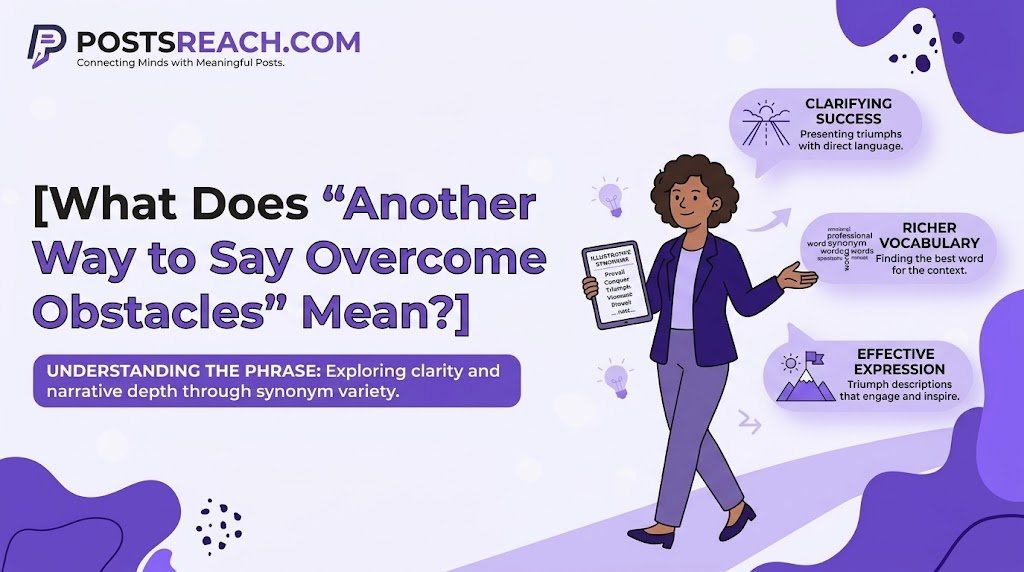
“Overcome obstacles” means successfully dealing with problems, barriers, or difficult circumstances that make it harder to reach a goal. The phrase emphasizes progress despite something standing in the way.
People commonly use it when discussing personal growth, education, careers, sports, business, leadership, and achievement. For example, someone might say, “She overcame obstacles to complete her degree.”
The expression can describe both practical barriers and broader challenges. Depending on the situation, you may want to emphasize persistence, resilience, problem-solving, or eventual success.
Why Use Other Ways to Say “Overcome Obstacles”?
Using different expressions can make your writing more precise and prevent the phrase from becoming repetitive. The right alternative can also change the emphasis of a sentence without changing its overall message.
You might use another phrase to:
- Avoid repeating “overcome obstacles.”
- Make professional writing more polished.
- Emphasize persistence or resilience.
- Describe challenges in a more natural way.
- Match formal, academic, motivational, or conversational writing.
10 Best Other Ways to Say “Overcome Obstacles”
1. Overcome Challenges
Meaning
“Overcome challenges” is one of the closest and most versatile alternatives to “overcome obstacles.” It means successfully dealing with difficult situations or problems that require effort, skill, or determination.
Best For
Professional, Formal, Friendly
Example 1
The team overcame several challenges while developing the new product.
Example 2
She learned how to overcome challenges without losing confidence in her abilities.
Quick Tip
Use this as a general-purpose replacement when you want to keep the original meaning and sound natural.
2. Face Difficulties
Meaning
“Face difficulties” focuses on encountering or dealing with problems rather than emphasizing that the person has already defeated them. It is useful when describing the process of dealing with hardship.
Best For
Professional, Formal, Casual
Example 1
Many small businesses face difficulties when expanding into new markets.
Example 2
He faced difficulties during his first year of college but continued working toward his goals.
Quick Tip
Use “face difficulties” when the challenge is ongoing or when you do not want to imply that it has already been resolved.
3. Overcome Adversity
Meaning
“Overcome adversity” is a stronger expression that usually refers to serious or prolonged hardship. It emphasizes resilience and the ability to move forward despite difficult circumstances.
Best For
Formal, Professional, Warm
Example 1
Her story shows how determination can help people overcome adversity.
Example 2
The organization was built by leaders who overcame significant adversity.
Quick Tip
Reserve this phrase for meaningful hardship rather than ordinary inconveniences.
4. Surmount Challenges
Meaning
“Surmount challenges” means successfully deal with or rise above difficult problems. “Surmount” has a more formal tone than “overcome,” so it often appears in professional, academic, and polished writing.
Best For
Formal, Professional
Example 1
The engineering team had to surmount several technical challenges before launching the system.
Example 2
Strong leadership helped the company surmount challenges during the transition.
Quick Tip
Choose “surmount” when you want your writing to sound polished without becoming overly complicated.
5. Navigate Challenges
Meaning
“Navigate challenges” suggests finding a way through difficult circumstances. Unlike “overcome,” it does not always imply that every problem has been completely defeated; instead, it emphasizes judgment, adaptability, and effective handling.
Best For
Professional, Formal
Example 1
New managers must learn to navigate challenges while supporting their teams.
Example 2
The company successfully navigated challenges caused by changes in customer demand.
Quick Tip
Use this phrase when the process of handling a difficult situation matters as much as the final result.
6. Push Through Difficulties
Meaning
“Push through difficulties” emphasizes determination and continued effort. It suggests that someone keeps moving forward even when circumstances become frustrating, demanding, or discouraging.
Best For
Casual, Friendly, Warm
Example 1
With steady effort, Marcus pushed through difficulties and finished the training program.
Example 2
The players pushed through difficulties and stayed focused until the final minutes of the game.
Quick Tip
This expression has an encouraging tone, making it useful for motivational writing and personal messages.
7. Conquer Barriers
Meaning
“Conquer barriers” presents obstacles as something that can be defeated or successfully removed. It has a strong, energetic tone and works best when you want to emphasize determination and achievement.
Best For
Formal, Friendly, Warm
Example 1
The program helps students conquer barriers that might prevent them from reaching their goals.
Example 2
She worked hard to conquer the barriers that had limited her opportunities.
Quick Tip
Use “conquer” when you want stronger language than the neutral “overcome.”
8. Rise Above Challenges
Meaning
“Rise above challenges” suggests maintaining strength, perspective, or determination despite difficult circumstances. It can emphasize emotional resilience as well as practical success.
Best For
Warm, Friendly, Professional
Example 1
He continued to rise above challenges and remain focused on his long-term goals.
Example 2
The community showed remarkable resilience as residents worked together to rise above challenges.
Quick Tip
This phrase works especially well when the person’s attitude matters as much as the outcome.
9. Work Through Problems
Meaning
“Work through problems” emphasizes the process of finding solutions to difficulties. It sounds practical and straightforward, making it useful when the obstacles require planning, communication, or problem-solving.
Best For
Professional, Casual, Friendly
Example 1
The team met every Friday to work through problems affecting the project.
Example 2
Good communication helped the two departments work through their differences.
Quick Tip
Choose this phrase when you want to emphasize practical problem-solving rather than dramatic achievement.
10. Persevere Through Adversity
Meaning
“Persevere through adversity” highlights continued effort despite serious difficulty. It focuses on persistence over time rather than simply describing the final success.
Best For
Formal, Professional, Warm
Example 1
The athlete persevered through adversity and continued training for the competition.
Example 2
Their ability to persevere through adversity became an important part of the organization’s story.
Quick Tip
Use this expression when persistence itself is the main quality you want to highlight.
Comparison Table
| Alternative | Best Used In | Tone |
|---|---|---|
| Overcome Challenges | General and professional writing | Neutral |
| Face Difficulties | Ongoing problems | Neutral |
| Overcome Adversity | Serious hardship | Strong |
| Surmount Challenges | Academic and professional writing | Formal |
| Navigate Challenges | Business and leadership | Professional |
| Push Through Difficulties | Personal and motivational writing | Encouraging |
| Conquer Barriers | Achievement-focused writing | Strong |
| Rise Above Challenges | Personal growth and resilience | Warm |
| Work Through Problems | Problem-solving situations | Practical |
| Persevere Through Adversity | Long-term hardship | Inspirational |
Common Mistakes
1. Treating Every Alternative as an Exact Synonym
The phrases differ in emphasis. “Navigate challenges” focuses on managing difficulty, while “conquer barriers” suggests defeating something that stands in the way.
2. Using “Adversity” for Minor Problems
“Adversity” generally suggests significant hardship. Using it for small inconveniences can make your writing sound exaggerated.
3. Choosing Overly Dramatic Language
Words such as “conquer” can sound powerful, but they may be inappropriate in a neutral business report. A simpler phrase such as “overcome challenges” may communicate the idea more naturally.
4. Ignoring Whether the Problem Is Ongoing
“Face difficulties” can describe a current situation, while “overcome challenges” usually suggests successful resolution. Make sure the verb matches the timeline of your sentence.
5. Focusing on Success When You Mean Persistence
If the important idea is continuing despite hardship, “persevere through adversity” may be more accurate than “overcome obstacles.” The distinction helps preserve your intended meaning.
Frequently Asked Questions
What is another way to say “overcome obstacles”?
Common alternatives include “overcome challenges,” “navigate challenges,” “surmount challenges,” “overcome adversity,” and “work through problems.” The best option depends on your intended meaning. “Overcome challenges” is the most flexible choice, while “persevere through adversity” emphasizes persistence and “navigate challenges” focuses on managing difficult situations.
What is a professional way to say “overcome obstacles”?
“Overcome challenges,” “navigate challenges,” and “surmount challenges” are strong professional alternatives. In business or workplace writing, “navigate challenges” can sound especially natural when describing how a person or organization handled changing conditions, complex projects, or unexpected problems.
What is a formal synonym for “overcome obstacles”?
“Surmount challenges” and “overcome adversity” are formal alternatives. “Surmount” means to successfully deal with something difficult, while “adversity” refers to serious hardship. Both can work in academic, professional, and formal writing when the context supports their stronger tone.
What is a motivational way to say “overcome obstacles”?
“Rise above challenges,” “push through difficulties,” and “persevere through adversity” have motivational qualities. These phrases focus on determination, resilience, and continued effort. For an encouraging message, “rise above challenges” sounds positive without being as forceful as “conquer barriers.”
Is “overcome challenges” the same as “overcome obstacles”?
The two phrases are very similar, but “challenges” is broader. An obstacle is something that blocks or slows progress, while a challenge can be any difficult task or situation. Because of this broader meaning, “overcome challenges” works naturally in more contexts.
What is another way to say “overcome obstacles” in an essay?
For an essay, you can use “overcome challenges,” “surmount challenges,” “overcome adversity,” or “navigate difficulties.” The best choice depends on the subject. Academic writing usually benefits from precise wording, so choose a phrase that describes whether the subject solved, managed, or persisted through the difficulty.
What is a simple way to say “overcome obstacles”?
“Get past challenges,” “work through problems,” or “deal with difficulties” can express the idea in simpler language. “Work through problems” is especially useful when the focus is on solving issues step by step rather than describing a major achievement.
How do you use “overcome obstacles” in a sentence?
You can use “overcome obstacles” when someone successfully deals with barriers that could prevent progress. For example, “The students overcame obstacles and completed the project on time.” The phrase works naturally in discussions about education, careers, personal development, sports, leadership, and achievement.
Conclusion
Finding another way to say “overcome obstacles” depends on the exact idea you want to express. If you need a simple, flexible replacement, “overcome challenges” works in most situations. For professional writing, “navigate challenges” emphasizes effective management, while “surmount challenges” gives the sentence a more formal tone.
When the situation involves serious hardship, “overcome adversity” or “persevere through adversity” may be more precise. For motivational writing, “rise above challenges” and “push through difficulties” highlight resilience and determination.
The most important distinction is between overcoming a problem and continuing to deal with it. Choose “overcome” when the focus is successful resolution, “navigate” when the process matters, and “persevere” when continued effort is the main idea. Precise wording makes your writing clearer and more convincing.

Adrian Vale is a digital content specialist focused on practical online content, emerging topics, and reader-focused publishing. He works on structuring articles for clarity and discoverability while keeping the writing natural, useful, and accessible to a broad audience.