Stop Saying “Not Surprisingly”: 10 More Formal Phrases
There are other ways to say not surprisingly, including as expected, unsurprisingly, as anticipated, predictably, and “as you might expect.” All of these phrases communicate that something was expected.
Depending on what you’re communicating, the best options will vary: use as expected for more neutral language, and be careful when using predictably since it has a more negative undertone.
Key Takeaways
- ‘Not surprisingly’, ‘as expected’ and similar phrases communicate that something was anticipated
- ‘As expected’ is a safe, general alternative to ‘not surprisingly’
- ‘Unsurprisingly’ works well in most formal writing contexts
- ‘As anticipated’ is useful for emphasizing that something was expected beforehand
- ‘Predictably’ has a negative undertone, so use it sparingly or not at all
What Does it Mean?
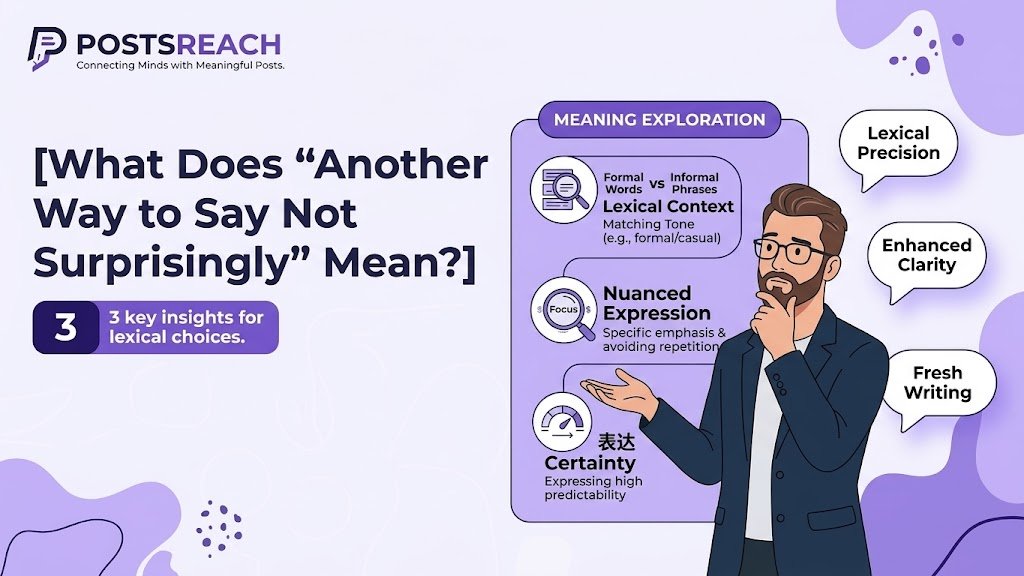
‘Not surprisingly’ refers to expressions that convey the same meaning.
The phrase ‘not surprisingly’ is used often to show that an outcome was expected. People use it in casual conversations, in formal writing, in research papers, in job interviews, and more.
For instance:
‘Not surprisingly, sales increased during the holiday season.’
could be replaced with:
‘As expected, sales increased during the holiday season.’
Being able to switch between these phrases is important because it allows you to vary your phrasing and avoid repetitive wording in your writing and speech.
Why Do We Need Other Ways to Say “Not Surprisingly”?
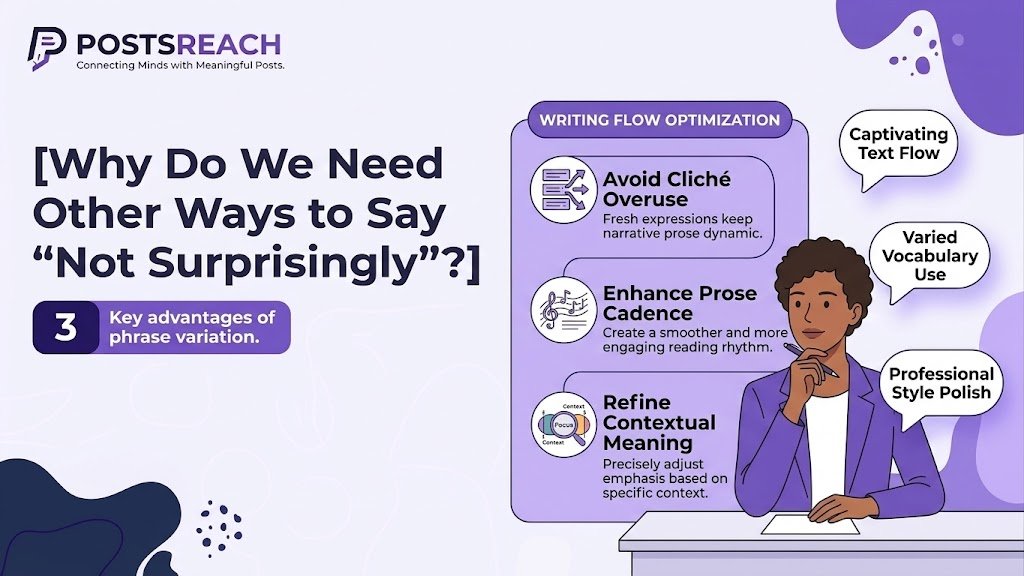
We need other ways to say ‘not surprisingly’ because there are other, nuanced ways to express that something happened as expected or was unremarkable. Substituting ‘not surprisingly’ with a phrase that communicates a slightly different meaning can be an effective way to vary your writing, avoid using the same word multiple times in a row or match the tone and mood of a conversation or piece of writing.
Other ways to say ‘not surprisingly’ are also useful because they help you specify how much you expected something to happen. For instance:
- Not surprisingly could communicate that you anticipated something to happen
- As anticipated could communicate that you expected something to happen
- As predicted could communicate that you made a specific prediction about something happening.
Depending on the context, being able to pick the exact phrase to say what you mean is extremely useful. It can also help vary the tone of your writing or speech.
The most useful alternate phrases to ‘not surprisingly’ will depend on the context. Some are fairly neutral, and some have a more formal or even negative undertone. It’s important to pick the phrase that best conveys the meaning and tone that you want to communicate.
10 Other Ways to Say “Not Surprisingly”
1. As Expected
Meaning
As expected communicates that you anticipated something to happen.
It’s one of the most neutral ways to replace the phrase ‘not surprisingly’.
See examples of how to use ‘as expected’ below.
Best For
Professional, formal, casual, polite
Example 1
As expected, the new schedule helped reduce customer wait times.
Example 2
As expected, the students did better after having practiced for weeks.
Quick Tip
As expected is useful in any context, since it is fairly neutral and not very formal.
2. Unsurprisingly
Meaning
Unsurprisingly directly conveys that something happened as expected; unsurprisingly means exactly what it says.
This word is an adverb which makes it a good alternative to the phrase ‘not surprisingly’, which is also an adverb.
It’s fairly similar to the phrase ‘as expected’, but it’s more formal and less commonly used. Use it to vary the level of formality.
See examples of how to use ‘unsurprisingly’ below.
Best For
Professional, formal
Example 1
Unsurprisingly, the most popular product sold out in under an hour.
Example 2
Unsurprisingly, senior staff picked up the new system faster than the others.
Quick Tip
Unsurprisingly is best reserved for formal writing – avoid using it too often, since it can become repetitive.
3. As Anticipated
Meaning
As anticipated means that something happened as expected.
As anticipated conveys a level of formality and has a slightly different nuance to ‘as expected’.
You can use ‘as anticipated’ in any context, though it’s more commonly used in professional contexts, and less often in casual ones.
See examples of how to use ‘as anticipated’ below.
Best For
Professional, formal
Example 1
As anticipated, the building project required additional resources.
Example 2
As anticipated, customer demand increased substantially after the new budget was announced.
Quick Tip
As anticipated is useful when you want to convey a slightly more formal and nuanced alternate to the phrase, ‘not surprisingly’.
4. As Predicted
Meaning
As predicted communicates that something happened as you predicted it would. This implies that you had specifically predicted the outcome.
Useful in formal writing and in casual communication, it has a slightly more assertive undertone than similar phrases like ‘unanticipatedly’.
See examples of how to use ‘as predicted’ below.
Best For
Professional, formal, casual
Example 1
As predicted, temperature dropped dramatically after the storm passed through.
Example 2
As predicted, the most recent update substantially increased application performance.
Quick Tip
As predicted should be used any situation where you specifically made a prediction and it came true — it implies that you had made an effort to forecast the outcome accurately.
5. As One Would Expect
Meaning
As one would expect communicates something happened as anticipated.
See examples of how to use ‘as one would expect’ below.
Best For
Formal, professional
Example 1
As one would expect, regular maintenance helped keep the equipment in working order.
Example 2
As one would expect, customers had more questions after the policy had changed.
Quick Tip
As one would expect works well in more formal settings or when you want to use a phrase that sounds a bit more academic.
6. As You Might Expect
Meaning
As you might expect communicates that something happened as you would expect it to happen. It puts focus on the reader, and implies that they would logically draw this conclusion themselves.
See examples of how to use ‘as you might expect’ below.
Best For
Friendly, casual, professional, polite
Example 1
As you might expect, the busiest stores had the longest checkout lines.
Example 2
As you might expect, learning a new skill takes time and practice.
Quick Tip
As you might expect is a good phrase to use if you want to imply a cause-effect relationship — something happened, and as a logical consequence, something else happened, too.
7. Predictably
Meaning
Predictably conveys that something happened predictably — in other words, it happened in a manner that could have been predicted.
Predictably has a more negative undertone than similar phrases, though it isn’t always the case.
See examples of how to use ‘predictably’ below.
Best For
Formal, professional
Example 1
Predictably, aging equipment needed more frequent repairs.
Example 2
Again, predictably, the last-minute change meant everyone was confused.
Quick Tip
Avoid using predictably if possible — it’s not commonly used, and it has a negative undertone that might not be appropriate for some situations.
8. Naturally
Meaning
Naturally conveys something happened as a matter of course — in other words, naturally.
Naturally has a slightly less formal tone than similar expressions and is often used in conversational contexts.
See examples of how to use ‘predictably’ below.
Best For
Casual, friendly, polite
Example 1
Naturally, the team wanted more time for the presentation.
Example 2
Naturally, the customer base was a curious about the updated offering.
Quick Tip
Naturally works similarly to ‘as one would expect’, but it has a more casual tone and should be used in less formal contexts.
9. Quite Expectedly
Meaning
Quite expectedly communicates that something happened quite expectedly. This is a fairly uncommon construction — quite expectedly is a valid word, but it’s not often used.
Best For
Formal
Example 1
Quite expectedly, the scope expansion increased the overall cost of the project.
Example 2
Quite expectedly, the announcement generated significant interest among stakeholders.
Quick Tip
Quite expectedly is best avoided — it’s an uncommon, overly complex way to say something that happened as expected.
10. It Was No Surprise That
Meaning
It was no surprise that conveys that something happened as a matter of fact — that is, there was nothing surprising about it.
It’s fairly versatile and works in a variety of contexts in written and verbal communication, although it’s more common in written communication. It was no surprise that puts a slightly stronger emphasis on the fact that something happened — it wasn’t a surprise, therefore, it happened as expected.
Best For
Professional, casual, friendly, polite
Example 1
It was no surprise that the experienced candidate handled the interview well.
Example 2
It was no surprise that the place was packed for the holiday season.
Quick Tip
It was no surprise that is a good phrase to use when you want to connect an outcome to a particular fact or circumstance.
Comparison Table
| Alternative | Best Used In | Tone |
|---|---|---|
| As expected | General, professional | Neutral |
| Unsurprisingly | Articles, reports | Formal |
| As anticipated | Business, planning | Professional |
| As predicted | Forecasting, results | Neutral |
| As one would expect | Analytical, explanation | Formal |
| As you might expect | Explanations, conversation | Casual |
| Predictably | Analysis, review | Formal |
| Naturally | Conversation | Casual |
| Quite expectedly | Formal writing | Formal |
| It was no surprise that | Explanations, storytelling | Neutral |
Common Mistakes
1. Using These Alternatives Interchangeably
While different alternatives to “not surprisingly” convey similar meanings, they aren’t all the same.
As one example, “as predicted” emphasizes that you specifically made a prediction, whereas “naturally” communicates that something occurred as a matter of course.
2. Using “Predictably” Without Considering Its Tone
Predictably has a more negative tone than other expressions. If there’s no nuance that you want to convey, consider using a more neutral alternative such as “as expected”.
3. Using Overly Formal Expressions in Casual Contexts
“As one would expect,” for instance, is a decent phrase to use in formal writing.
However, it doesn’t sound natural in a conversation or a casual email.
4. Claiming That Something Happened Without Providing Context
When using “as predicted,” for instance, readers and listeners might wonder who predicted it.
If there isn’t a clear context, consider using a different alternative to “not surprisingly.”
5. Overusing Expectation Phrasing
Alternatives to “not surprisingly” tend to be strong transition words, but transition words should generally be used in moderation. Using these words more than you should will weaken their impact and potentially annoy your audience.
Frequently Asked Questions
What Is a Professional Way to Say “Not Surprisingly”?
The phrase “as expected” is useful in professional contexts since it implies that you anticipated the outcome without using strong or otherwise unnecessary language. “As anticipated” is also a good professional alternative since it conveys similar nuance but in a slightly different way.
What Is a Formal Synonym for “Not Surprisingly”?
As a general rule, “unsurprisingly” is a good alternative expression in formal writing contexts. “Unsurprisingly,” “as anticipated,” and “as one would expect” can all be used in more formal writing depending on the context, though “unsurprisingly” may be the most similar to the phrase “not surprisingly.”
What Is a Casual Way to Say “Not Surprisingly”?
As a matter of fact, in casual communications, “as expected” and “naturally,” as well as “as you might expect,” tend to be fairly natural ways to replace “not surprisingly.” For example, the phrase “As you might expect, everyone was happy to hear about the weekend news” would sound fairly casual in a conversation in American English.
Is “Unsurprisingly” the Same Thing as “Not Surprisingly”?
Yes, the expressions “unsurprisingly” and “not surprisingly” convey similar meaning, though the former tends to sound slightly more formal and less conversational than the latter.
What Is “Not Surprisingly” in an Essay?
“As expected,” “unsurprisingly,” and “as anticipated” are all good expressions to say something unexpected in an essay or other academic paper.
“As expected” is fairly general-purpose, while “as anticipated” has a slightly more formal tone. You can also consider “as one would expect” if you want a more complex construction that still sounds natural in an academic paper.
Can “Predictably” Be Used to Replace “Not Surprisingly”?
“Predictably” and “not surprisingly” are fairly similar expressions, but the former has a slightly more negative tone. “Not surprisingly,” for instance, sounds more neutral, whereas “predictably” could be interpreted as a slight reproach or disapproval.
Which Is Better: “As Expected” or “As Predicted”?
“As expected” implies that something occurred as you thought it would, but “as predicted” implies that you specifically made a prediction about it. In other words, “as predicted” can be used to talk about weather forecasts or any other outcome for which a specific prediction was made. “As expected,” on the other hand, can refer to any result that wasn’t unexpected in a given context.
Can “Naturally” Be Used to Replace “Not Surprisingly”?
“Naturally” can replace the phrase “not surprisingly” in some cases, but it conveys slightly different connotations.
“Naturally” usually refers to something that is expected to occur, whereas “not surprisingly” refers to something that simply occurred as expected.
Conclusion
There are many other ways to say not surprisingly — as well as subtle differences between many of these phrases.
“As expected,” for instance, is a fairly general-purpose phrase that can be used across a variety of settings and audiences. It conveys that you anticipated the outcome without emphasizing it. “Unsurprisingly” is similar but has a slightly more formal tone and implies greater surprise at the outcome. “As anticipated” and “as predicted” convey a slightly different nuance: namely, that you had expected the outcome to occur beforehand.
“Predictably” has similar connotations to “unsurprisingly,” but it has a more negative undertone. “Naturally” and “as you might expect” can be used in some cases as conversational substitutes for “not surprisingly,” but they tend to have slightly different meanings. Meanwhile, “it was no surprise that” is useful in a wide variety of contexts because it can be combined with other phrases to help describe the outcome in more detail.

The PostsReach Editorial Team develops, reviews, and maintains the site’s published content. The team works across topics to ensure articles are clear, useful, well-structured, and consistent with PostsReach’s editorial standards. Content may be reviewed and updated as information changes.