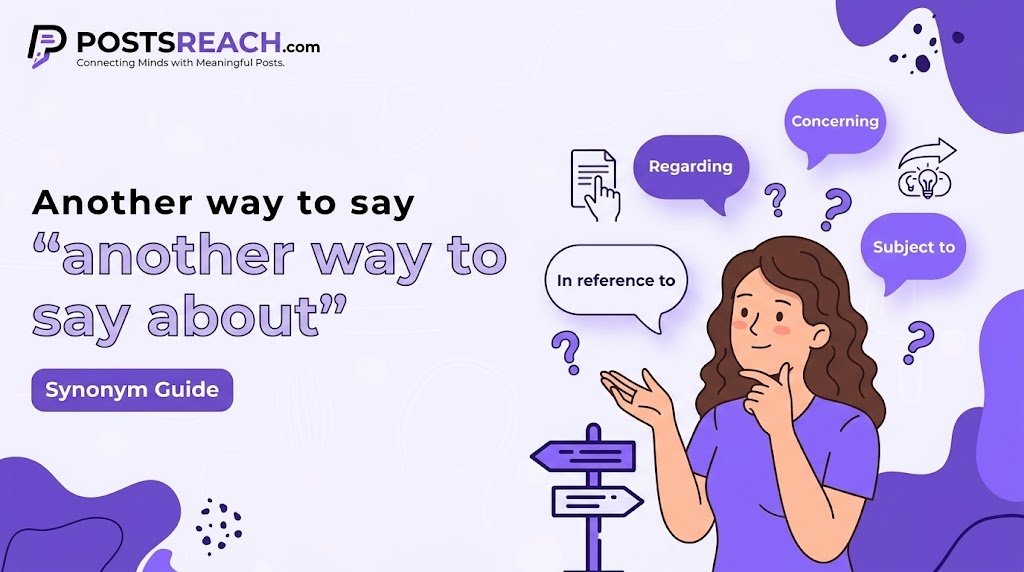
Another Way to Say “About”: 10 Polished Alternatives
Another way to say “about” depends on the context. Useful alternatives include “regarding,” “concerning,” “approximately,” “around,” and “related to.” Use “regarding” in professional messages, “approximately” for estimates, and “related to” when discussing a topic. Choosing the right expression keeps your writing clear and natural.
Key Takeaways
- “Regarding” works well in professional emails and formal communication.
- “Concerning” introduces a subject or matter being discussed.
- “Approximately” and “around” express estimates or amounts.
- “Related to” connects a subject with another topic.
- Choose an alternative based on whether “about” means concerning, approximately, or around a subject.
“About” is a common English word with several meanings. It can introduce a topic, describe an approximate amount, or refer to something nearby or in a particular area.
For example, “I emailed you about the meeting” introduces a subject, while “The trip takes about two hours” gives an estimate. Because the meaning changes with context, the best alternative depends on how the word is used in the sentence.
Learning suitable replacements can help you write clearer emails, improve professional communication, and avoid repeating the same expression.
What Does “About” Mean?
The word “about” is commonly used in three ways.
First, it can mean concerning or related to a subject. For example, “We talked about the new project” means the project was the topic of the conversation.
Second, it can mean approximately. In “The package weighs about five pounds,” the speaker gives an estimate rather than an exact measurement.
Third, “about” can describe movement or presence in an area, as in “She walked about the room.” This usage is less common in everyday American English than the first two meanings.
The word appears in conversations, emails, reports, academic writing, instructions, and everyday descriptions. Understanding its role in a sentence helps you select a replacement that preserves the intended meaning.
Why Use Other Ways to Say “About”?
Using different expressions can make your writing more precise and help you match the tone of your message.
Consider an alternative when you want to:
- Avoid repeating the same word throughout a document.
- Make professional emails sound more polished.
- Introduce a topic more clearly.
- Express estimates accurately.
- Improve sentence flow in reports and articles.
- Choose language that suits formal or casual communication.
The important point is not to replace “about” every time you use it. In many sentences, “about” is already the most natural choice.
10 Best Other Ways to Say “About”
1. Regarding
Meaning
“Regarding” means concerning a particular subject or matter. It is especially useful when introducing the topic of an email, report, announcement, or professional conversation.
Best For
- Professional
- Formal
- Polite
Example 1
I’m writing regarding your application for the marketing position.
Example 2
We received several questions regarding the updated return policy.
Quick Tip
Use “regarding” to introduce a clear topic in professional communication. It usually sounds more formal than “about.”
2. Concerning
Meaning
“Concerning” means relating to or dealing with a particular subject. It is useful in formal messages, reports, and discussions where the topic needs to be identified clearly.
Best For
- Formal
- Professional
Example 1
The committee requested additional information concerning the proposed changes.
Example 2
I have a question concerning the final payment on my account.
Quick Tip
Use “concerning” when you want a formal tone, but avoid choosing it simply to make ordinary writing sound more complicated.
3. Approximately
Meaning
“Approximately” means close to a particular number, amount, measurement, or time, without being exact. It is common in reports, research, estimates, and technical explanations.
Best For
- Professional
- Formal
Example 1
The installation should take approximately three hours.
Example 2
Approximately 250 people attended the community event.
Quick Tip
Use “approximately” when accuracy matters but the figure is an estimate. In casual conversation, “about” or “around” may sound more natural.
4. Around
Meaning
“Around” can mean approximately when referring to numbers, times, distances, or quantities. It is a natural choice in everyday American English and often sounds less formal than “approximately.”
Best For
- Casual
- Friendly
- Professional
Example 1
Let’s meet around 4 p.m. if that works for you.
Example 2
The replacement parts cost around $80 altogether.
Quick Tip
Use “around” for informal estimates. For a formal report requiring a more professional tone, consider “approximately.”
5. Related To
Meaning
“Related to” describes a connection between a subject and another matter. It is useful when discussing topics, responsibilities, events, or information that has a clear link to something else.
Best For
- Professional
- Formal
- Casual
Example 1
Please send me the documents related to the property purchase.
Example 2
The workshop covers several topics related to digital marketing.
Quick Tip
Use “related to” when emphasizing a connection, not simply as a replacement in every sentence that contains “about.”
6. In Reference To
Meaning
“In reference to” introduces the subject or matter being discussed. It is commonly used in business correspondence, although shorter expressions such as “regarding” often make sentences easier to read.
Best For
- Professional
- Formal
Example 1
I’m contacting you in reference to the invoice sent last Friday.
Example 2
In reference to your earlier request, the revised document is attached.
Quick Tip
This phrase can sound formal and wordy. In most short emails, “regarding” is a more concise option.
7. With Respect To
Meaning
“With respect to” means concerning a particular issue, aspect, or area. It often appears in business reports, academic writing, and technical discussions where the writer needs to identify a specific point.
Best For
- Formal
- Professional
Example 1
We need to review the policy with respect to customer privacy.
Example 2
The report identifies several improvements with respect to energy use.
Quick Tip
Use this expression when discussing a specific aspect of a broader topic. Avoid overusing it in simple sentences.
8. On the Subject Of
Meaning
“On the subject of” introduces a topic for discussion or brings attention back to a particular matter. It can work in conversations, presentations, articles, and informal transitions between ideas.
Best For
- Casual
- Friendly
- Professional
Example 1
On the subject of travel, have you booked your hotel yet?
Example 2
The podcast includes an interesting discussion on the subject of online privacy.
Quick Tip
Use this phrase to introduce or return to a topic. For a short professional email, “regarding” may be more direct.
9. Involving
Meaning
“Involving” describes something that includes, affects, or requires a person, activity, or issue. It works when “about” refers to the people or elements connected with a situation.
Best For
- Professional
- Formal
Example 1
The company is reviewing complaints involving delayed deliveries.
Example 2
She accepted a role involving customer research and product testing.
Quick Tip
Use “involving” when something includes or affects specific people or activities. It does not replace “about” naturally in every context.
10. Concerning the Topic of
Meaning
“Concerning the topic of” explicitly identifies the subject under discussion. Although grammatically possible, it is often longer than necessary because “concerning” already introduces a topic.
Best For
- Formal
- Professional
Example 1
The speaker answered several questions concerning the topic of workplace safety.
Example 2
The students prepared presentations concerning the topic of renewable energy.
Quick Tip
For clearer writing, consider shortening this phrase to “concerning workplace safety” or “about workplace safety.”
Comparison Table
| Alternative | Best Used In | Tone |
|---|---|---|
| Regarding | Emails and business messages | Professional |
| Concerning | Reports and formal discussions | Formal |
| Approximately | Measurements and estimates | Precise |
| Around | Everyday estimates | Casual |
| Related To | Topics and connections | Neutral |
| In Reference To | Business correspondence | Formal |
| With Respect To | Specific issues or aspects | Technical |
| On the Subject Of | Conversations and transitions | Conversational |
| Involving | Activities and situations | Professional |
| Concerning the Topic of | Explicit topic introductions | Formal |
Common Mistakes
1. Using “Regarding” for Approximate Numbers
“Regarding” introduces a subject; it does not mean approximately. For example, “The meeting lasted regarding two hours” is incorrect. Write “The meeting lasted about two hours” or “approximately two hours.”
2. Choosing Formal Expressions for Casual Conversations
Phrases such as “with respect to” may sound unnecessarily stiff in a text message. Use straightforward wording unless the situation calls for a formal tone.
3. Treating Every Alternative as an Exact Synonym
“Approximately” expresses an estimate, while “related to” expresses a connection. Before replacing a word, identify what it means in the original sentence.
4. Using Wordy Phrases Unnecessarily
“In reference to” and “concerning the topic of” can make simple messages longer than needed. Shorter alternatives often improve clarity without losing important information.
5. Ignoring Sentence Structure
A replacement may require changes to the rest of the sentence. Read the revised sentence aloud to check that it sounds natural and communicates the intended meaning.
Frequently Asked Questions
What is a professional way to say “about”?
“Regarding” is a useful professional alternative when introducing a topic in an email, report, or business discussion. For example, “I’m emailing you about the schedule” can become “I’m emailing you regarding the schedule.” “Concerning” is another option for formal writing, though it can sound more serious.
What is another word for “about” in an essay?
Depending on the sentence, you can use “regarding,” “concerning,” “related to,” or “with respect to.” For example, “This essay is about renewable energy” could become “This essay examines renewable energy.” Often, rewriting the sentence with a precise verb makes academic writing clearer than swapping one word for another.
How can I say “about” in a formal email?
Try “regarding,” “in reference to,” or “with respect to,” depending on the purpose of your message. “Regarding” is usually concise and professional. For example, “I have a question about my order” can become “I have a question regarding my order.”
What can I use instead of “about” when giving an estimate?
Use “approximately,” “around,” or “roughly.” These expressions communicate that a number, amount, or time is not exact. “Approximately” suits reports and formal contexts, while “around” and “roughly” are common in everyday conversation. Choose the expression that matches the precision and tone you need.
Is “regarding” more formal than “about”?
Generally, yes. “Regarding” often sounds more formal and is common in professional correspondence, while “about” is neutral and widely used in everyday English. Neither is automatically better. Choose the word that makes your sentence clear and appropriate for the audience.
What is the difference between “about” and “concerning”?
When they introduce a subject, “about” and “concerning” can have similar meanings. “Concerning” often sounds more formal. However, “concerning” can also mean causing worry, as in “The results are concerning.” The intended meaning depends on how the word functions in the sentence.
Can I use “related to” instead of “about”?
Yes, when you mean that something has a connection to a subject. For example, “We discussed issues about the website” could become “We discussed issues related to the website.” However, “related to” may suggest a connection rather than making the topic of discussion the main focus.
What is the simplest alternative to “about”?
“Regarding” works for many topic-related sentences, while “around” or “approximately” works for estimates. Still, “about” is often the simplest and most natural choice in everyday English. You do not need to replace it when it already communicates your meaning clearly.
Conclusion
The best alternative depends on what “about” means in your sentence. Use “regarding” or “concerning” when introducing a subject in professional writing. Choose “approximately” for estimates and “around” for a more conversational tone. When you want to show a connection between ideas, “related to” may be more precise.
Other expressions, such as “in reference to” and “with respect to,” can suit formal documents, but they may make simple sentences unnecessarily long. In many cases, the original word is still the clearest choice.
Before making a substitution, identify the intended meaning and consider your audience. Good writing is not about replacing common words with complicated expressions; it is about choosing language that communicates your message accurately and naturally.

The PostsReach Editorial Team develops, reviews, and maintains the site’s published content. The team works across topics to ensure articles are clear, useful, well-structured, and consistent with PostsReach’s editorial standards. Content may be reviewed and updated as information changes.