Another Way to Say “Other”: 10 Alternatives You’ll Actually Use
If you need another way to say “other,” useful alternatives include additional, different, alternative, another, extra, remaining, separate, further, distinct, and else. The best choice depends on context. For example, “additional” works well in professional writing, while “different” is more natural when comparing people, ideas, or things.
Key Takeaways
- “Other” can mean additional, different, remaining, or separate depending on context.
- Additional and further work well in professional and formal writing.
- Different is useful when you want to show contrast or variation.
- Another often works when referring to one more person or thing.
- Always choose a synonym based on the sentence’s exact meaning and tone.
What Does “Another Way to Say Other” Mean?
The phrase “another way to say other” refers to finding a synonym or alternative expression for the word “other.” Since “other” has several meanings, the best replacement depends on how you use it in a sentence.
For example, “other options” could become “additional options,” while “other people” might become “different people.” In some situations, “remaining,” “separate,” or “alternative” may be more precise.
People often look for alternatives to “other” to avoid repetition, improve word choice, or make their writing sound more natural.
Why Use Other Ways to Say “Other”?
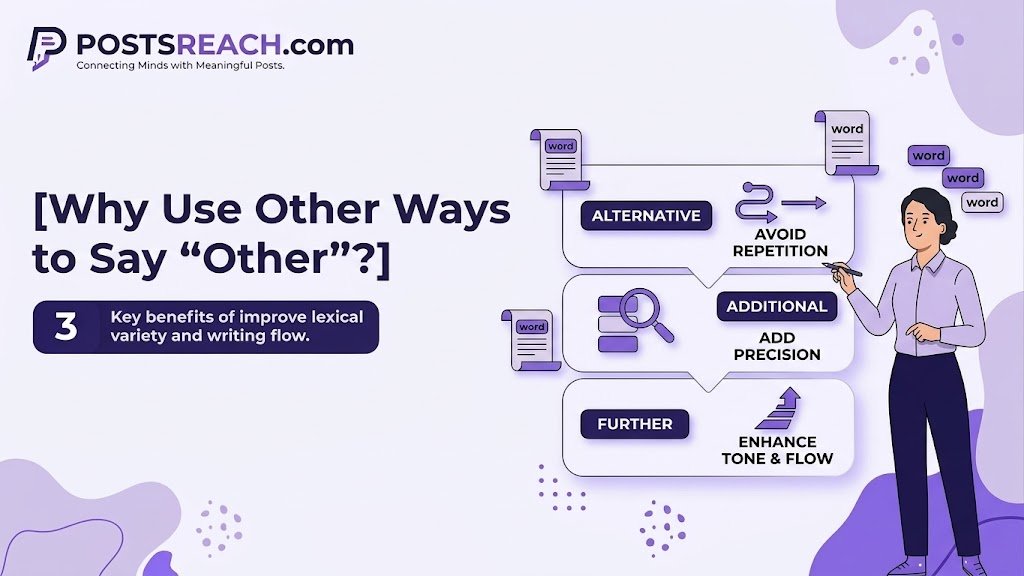
Although “other” is a common and useful word, repeating it too often can make writing feel plain or repetitive. A more precise alternative can also clarify what you actually mean.
Using a suitable synonym can help you:
- Avoid unnecessary repetition.
- Make your writing more specific.
- Create smoother sentences.
- Match professional or casual communication.
- Show differences more clearly.
- Choose a word that fits the exact context.
The key is not to replace “other” automatically. Instead, consider whether you mean additional, different, separate, remaining, alternative, or something else.
10 Best Other Ways to Say “Other”
1. Additional
Meaning
Additional means something extra that has been added to what already exists. It is one of the most useful alternatives to “other” when you are talking about more items, information, resources, or choices.
Best For
- Professional
- Formal
- Polite
Example 1
Please contact us if you need additional information about the application process.
Example 2
The manager requested additional documents before approving the request.
Quick Tip
Use additional when “other” means more or extra, especially in professional writing.
2. Different
Meaning
Different describes something that is not the same as another person, thing, idea, or situation. It is a natural choice when “other” is being used to show contrast.
Best For
- Professional
- Casual
- Friendly
Example 1
We should consider a different approach to solve the problem.
Example 2
She decided to try a different restaurant after checking the menu.
Quick Tip
Choose different when you want to emphasize that two things are not the same.
3. Another
Meaning
Another generally means one more or an additional person or thing. It is especially useful when you are referring to a singular noun.
Best For
- Casual
- Professional
- Friendly
Example 1
Could you send me another copy of the contract?
Example 2
Let’s schedule another meeting for next week.
Quick Tip
Use another before a singular countable noun when you mean one more.
4. Alternative
Meaning
Alternative refers to another option, choice, or method that can be considered instead of the original one. It often suggests that someone must choose between possibilities.
Best For
- Professional
- Formal
Example 1
The team proposed an alternative solution to the technical issue.
Example 2
We need an alternative plan in case the event is canceled.
Quick Tip
Use alternative when you are talking about a replacement or another possible choice.
5. Extra
Meaning
Extra means more than what is normally expected, required, or included. It is short and natural, making it especially common in everyday American English.
Best For
- Casual
- Friendly
- Professional
Example 1
Do you have any extra chairs we can use?
Example 2
The hotel provided extra towels for the guests.
Quick Tip
Use extra for something added beyond the normal amount or requirement.
6. Further
Meaning
Further can mean additional or more, particularly when discussing information, discussion, action, or progress. It is common in professional and formal communication.
Best For
- Professional
- Formal
- Polite
Example 1
Please let me know if you require further assistance.
Example 2
The issue will require further investigation before we make a decision.
Quick Tip
Further works particularly well with abstract nouns such as “information,” “discussion,” “review,” and “investigation.”
7. Remaining
Meaning
Remaining refers to what is still left after some people or things have been removed, used, selected, or discussed. It is more precise than “other” when you mean what is left.
Best For
- Professional
- Formal
Example 1
The remaining items will be shipped tomorrow.
Example 2
Please place the remaining files in the archive folder.
Quick Tip
Use remaining when “other” means the ones still left.
8. Separate
Meaning
Separate describes something that is apart from another person, group, category, or thing. It emphasizes distinction or division rather than simply meaning “more.”
Best For
- Professional
- Formal
- Casual
Example 1
The company maintains a separate account for business expenses.
Example 2
Please submit the receipts in a separate folder.
Quick Tip
Use separate when the important idea is that something is kept apart or treated independently.
9. Distinct
Meaning
Distinct means clearly different or separate from something else. It is more precise and formal than “other,” so it can be useful in academic, business, and analytical writing.
Best For
- Formal
- Professional
Example 1
The report identifies two distinct trends in consumer behavior.
Example 2
Each department has a distinct role within the organization.
Quick Tip
Choose distinct when you want to emphasize a clear difference between two things.
10. Else
Meaning
Else generally means something or someone additional or different from what has already been mentioned. It commonly appears after words such as “what,” “who,” “where,” and “anything.”
Best For
- Casual
- Friendly
- Polite
Example 1
Is there anything else you need before I leave?
Example 2
Who else is attending the meeting?
Quick Tip
Else is especially natural in questions and expressions such as “anything else,” “someone else,” and “where else.”
Comparison Table
| Alternative | Best Used In | Tone |
|---|---|---|
| Additional | More information or items | Professional |
| Different | Showing contrast | Neutral |
| Another | One more item or person | Neutral |
| Alternative | Another possible choice | Formal |
| Extra | More than expected | Casual |
| Further | More information or action | Formal |
| Remaining | What is still left | Professional |
| Separate | Something kept apart | Neutral |
| Distinct | Clearly different categories | Formal |
| Else | Additional or different people/things | Casual |
Common Mistakes
1. Replacing “other” without checking the meaning
Not every synonym works in every sentence. “Additional” means more, while “different” means not the same, so swapping them can change the sentence’s meaning.
2. Using overly formal language
Words such as distinct and alternative can sound too formal in casual conversation. In everyday situations, “different” or “another” may sound more natural.
3. Using “another” with uncountable nouns
“Another” normally works with singular countable nouns, such as “another idea” or “another book.” For uncountable nouns, use expressions such as “additional information” instead.
4. Ignoring context
“Remaining,” “separate,” and “additional” describe different relationships. Identify what you mean before selecting a replacement.
5. Repeating one synonym too often
Replacing every instance of “other” with the same alternative can create another form of repetition. Vary your wording only when the meaning remains accurate.
Frequently Asked Questions
What is a better word for “other”?
There is no single replacement that works in every sentence. Additional, different, another, alternative, extra, further, remaining, separate, distinct, and else can all replace “other” in specific contexts. The right choice depends on whether you mean something more, something different, something remaining, or another possible option.
What is a professional way to say “other”?
Additional, further, alternative, and separate are useful professional alternatives. For example, instead of saying “Please provide other information,” you could write, “Please provide additional information.” The revised sentence sounds clearer and more natural in a workplace setting.
What is another word for “other” in an essay?
For essays, useful alternatives include different, additional, alternative, further, distinct, and remaining. However, the best choice depends on the sentence. Academic writing benefits more from precise word choice than from replacing “other” simply to avoid repetition.
Can “different” replace “other”?
Yes, but only when “other” refers to something that is not the same. For example, “We need other ideas” could become “We need different ideas.” However, “other information” usually means additional information, so “additional” would be more accurate there.
Is “another” the same as “other”?
They are related but not identical. Another usually means one more or an additional one, while other can refer to additional, different, or remaining people or things. For example, “another option” means one more option, while “other options” can refer to several alternatives.
What is a formal synonym for “other”?
Depending on the context, additional, alternative, further, distinct, or separate may work as formal alternatives. There is no universal formal synonym because each word carries a slightly different meaning.
What is a casual way to say “other”?
In casual American English, another, different, extra, and else are often natural choices. For example, “Do you need anything else?” sounds more conversational than “Do you require any additional items?”
How do I avoid repeating the word “other”?
First, identify what “other” means in the sentence. If it means more, try additional; if it means not the same, use different; if it means one more, use another; and if it means what is left, use remaining.
Conclusion
Finding another way to say “other” is less about memorizing synonyms and more about choosing the word that matches your meaning. Additional works when you mean more, different highlights contrast, and another usually means one more. For choices, alternative is useful, while remaining describes what is left. Separate and distinct emphasize differences or division, and else fits naturally into many everyday questions.
The best synonym also depends on tone. Professional writing may favor “additional” or “further,” while casual conversation often sounds better with “another,” “different,” or “else.” Before replacing “other,” check the exact relationship between the things you are describing. Precise word choice will make your writing clearer, more natural, and easier to understand.

Rowan Mercer is a senior content editor focused on producing clear, useful, and engaging digital content. Rowan specializes in researching complex topics, organizing information into reader-friendly formats, and maintaining high standards for accuracy, clarity, and editorial quality.