
10 Best Alternatives for “Give” in English
The verb “give” is one of the most common words in English. It can describe many different actions, from handing someone an object to providing information, offering help, donating money, granting permission, or creating an opportunity.
Because “give” has so many meanings, replacing it with a single synonym does not always work. The right alternative should preserve the original meaning while making the sentence clearer, more precise, or better suited to its tone.
For example, “give information” can become “provide information,” while “give someone an opportunity” can become “offer someone an opportunity.” Similarly, “give permission” is often better expressed as “grant permission.”
Key Takeaways
- Provide is a strong professional alternative when supplying something useful or needed.
- Offer works well for help, opportunities, choices, and things someone can accept or decline.
- Present is appropriate for gifts, awards, ideas, and formal presentations.
- Grant is best for permission, rights, requests, or official benefits.
- The best synonym for “give” depends on what you are giving, who receives it, and the situation.
What Does “Another Way to Say Give” Mean?
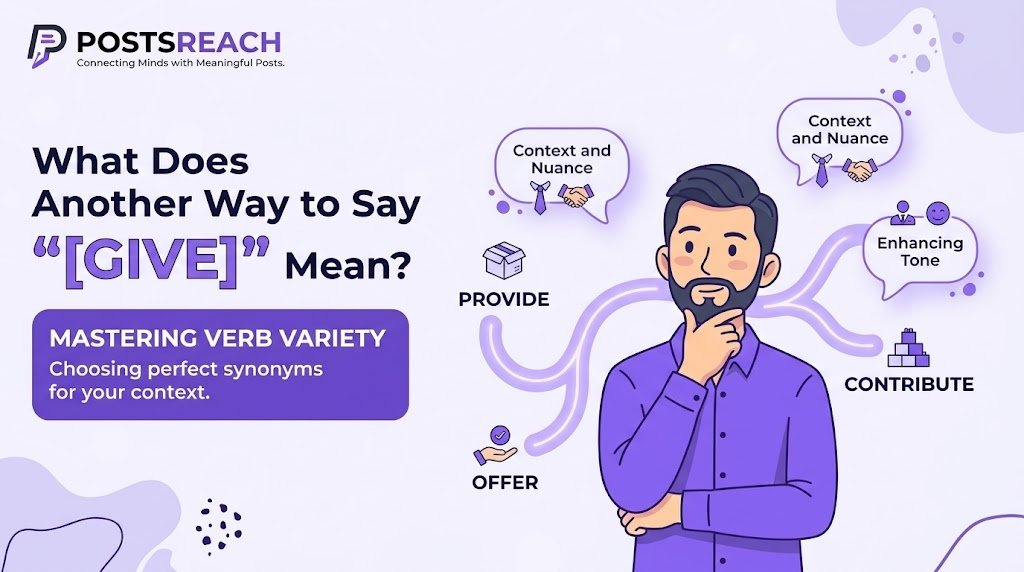
“Another way to say give” means finding a different English word or phrase that expresses the specific meaning of give in a sentence.
The word can have several meanings:
- To hand something to someone: give → hand
- To supply something: give → provide
- To suggest or make something available: give → offer
- To formally show or deliver something: give → present
- To officially allow something: give → grant
- To provide something as a gift: give → donate
- To contribute something: give → contribute
- To deliver something: give → deliver
- To distribute something: give → supply
- To recognize someone with an honor: give → award
This distinction matters because synonyms are not always interchangeable. A word that works perfectly in one sentence may sound unnatural or change the meaning in another.
Why Use Other Ways to Say “Give”?
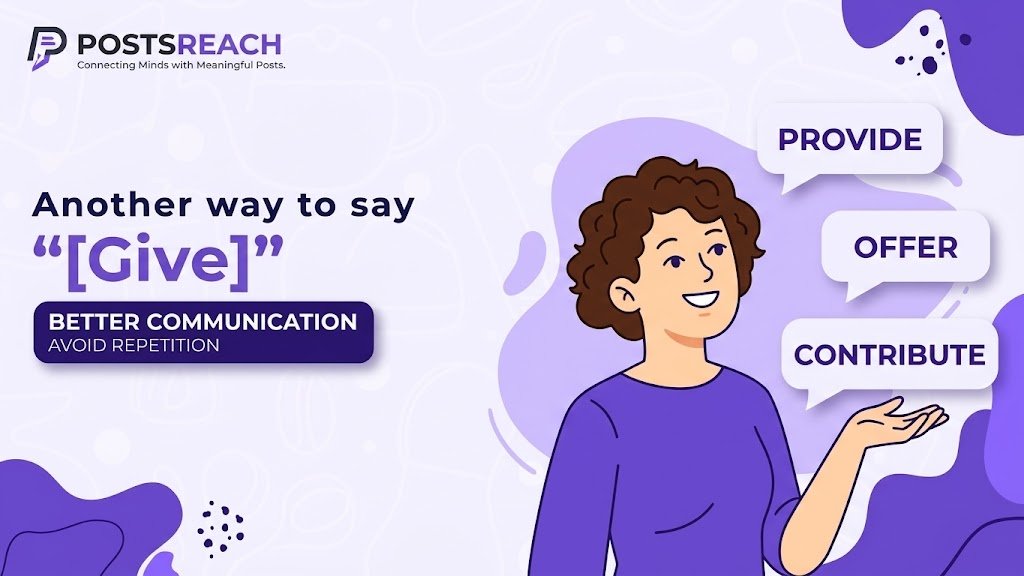
Using more precise alternatives can make your English clearer and more effective. It is especially helpful when writing professional emails, essays, reports, websites, marketing content, and academic work.
You may want another word for “give” to:
- Avoid repeating the same word.
- Make your writing more precise.
- Match a professional or formal tone.
- Describe the exact action more clearly.
- Make business communication sound polished.
- Improve vocabulary variety.
- Avoid vague or repetitive sentences.
The goal is not to replace “give” whenever possible. “Give” is often the most natural choice. Use an alternative when it communicates the intended meaning more accurately.
10 Best Other Ways to Say “Give”
1. Provide
Meaning
“Provide” means to supply or make something available to someone. It is one of the strongest alternatives to “give” in professional and formal English.
Best For
- Professional
- Formal
- Polite
Example 1
“Our team will provide detailed instructions before the project begins.”
Example 2
“The school provides students with access to online learning resources.”
Quick Tip
Use “provide” with things such as information, services, support, resources, assistance, and access.
2. Offer
Meaning
“Offer” means to make something available for someone to accept or use. Unlike “give,” it often suggests that the receiver has a choice about whether to accept it.
Best For
- Professional
- Friendly
- Polite
- Formal
Example 1
“The company offered me an opportunity to join the design team.”
Example 2
“Can I offer you some help with that assignment?”
Quick Tip
“Offer” is especially useful with help, advice, opportunities, assistance, choices, and services.
3. Supply
Meaning
“Supply” means to provide something that is needed, usually in a sufficient or continuing amount. It is common when discussing products, materials, equipment, or resources.
Best For
- Professional
- Formal
Example 1
“The manufacturer supplies restaurants with fresh ingredients.”
Example 2
“We need to supply the team with the equipment they need.”
Quick Tip
Use “supply” when the focus is on meeting a need or maintaining an available amount.
4. Present
Meaning
“Present” can mean formally giving something to someone, such as an award, gift, certificate, or document. It can also mean showing or explaining information to an audience.
Best For
- Formal
- Professional
- Polite
Example 1
“The director presented the winner with a certificate.”
Example 2
“She will present her research to the board next Monday.”
Quick Tip
Use “present” when the action has a formal, ceremonial, or public quality.
5. Grant
Meaning
“Grant” means to officially give someone permission, a right, a request, or a benefit. It is more formal than the everyday word.
Best For
- Formal
- Professional
- Polite
Example 1
“The manager granted the employee permission to work remotely.”
Example 2
“The organization granted the researchers additional funding.”
Quick Tip
“Grant” commonly appears with permission, approval, access, rights, requests, and funding.
6. Donate
Meaning
“Donate” means to give money, goods, time, or other resources voluntarily, usually to help a person, organization, or cause.
Best For
- Formal
- Professional
- Warm
- Polite
Example 1
“Local businesses donated supplies to the community center.”
Example 2
“Many families donated clothes to the annual charity drive.”
Quick Tip
Use “donate” when the purpose is helping a cause, organization, or people in need.
7. Hand
Meaning
“Hand” means to give something directly to another person, usually by physically passing it to them. It is more specific and conversational than “give.”
Best For
- Casual
- Friendly
Example 1
“Could you hand me the notebook on the desk?”
Example 2
“She handed her friend the keys before leaving.”
Quick Tip
Choose “hand” when the action involves physically passing an object from one person to another.
8. Share
Meaning
“Share” means to give someone access to something you have, such as information, ideas, experiences, resources, or opinions. It often suggests that both people can benefit from the information or resource.
Best For
- Casual
- Friendly
- Professional
- Warm
Example 1
“Thanks for sharing your ideas during the meeting.”
Example 2
“He shared the project files with the rest of the team.”
Quick Tip
Use “share” for information, ideas, opinions, experiences, files, resources, and similar things.
9. Contribute
Meaning
“Contribute” means to give something as part of a larger effort, project, group, or cause. The contribution can be money, time, knowledge, ideas, work, or resources.
Best For
- Professional
- Formal
- Polite
Example 1
“Several employees contributed ideas to improve the new website.”
Example 2
“She contributed her design skills to the community project.”
Quick Tip
Use “contribute” when the thing being given becomes part of a shared effort or larger goal.
10. Award
Meaning
“Award” means to officially give someone a prize, honor, contract, scholarship, or similar recognition because of an achievement or decision.
Best For
- Formal
- Professional
Example 1
“The committee awarded Maria a scholarship for her academic achievement.”
Example 2
“The organization awarded the contract to a local design firm.”
Quick Tip
Use “award” when something is given as the result of a formal decision, competition, achievement, or selection process.
Comparison Table
| Alternative | Best Used In | Tone |
|---|---|---|
| Provide | Information, services, support, resources | Professional |
| Offer | Help, opportunities, advice, choices | Friendly, professional |
| Supply | Products, materials, equipment, resources | Formal |
| Present | Awards, gifts, documents, presentations | Formal |
| Grant | Permission, rights, approval, funding | Formal |
| Donate | Money, goods, time, charitable support | Warm, formal |
| Hand | Physical objects | Casual |
| Share | Ideas, information, files, experiences | Friendly, neutral |
| Contribute | Projects, causes, group efforts | Professional |
| Award | Prizes, scholarships, contracts, honors | Formal |
Common Mistakes
1. Treating every synonym as interchangeable
Words that are related to “give” can have different meanings. “Donate,” for example, implies voluntary support, while “provide” simply means supplying something.
2. Using overly formal words in casual conversations
Saying “I will provide you with the keys” can sound stiff in an everyday situation. “I’ll give you the keys” or “I’ll hand you the keys” is more natural.
3. Using “offer” when there is no choice
“Offer” often suggests that someone can accept or reject something. If you are simply supplying required information, “provide” may be more accurate.
4. Confusing “award” with ordinary giving
You do not normally “award” someone a casual gift. “Award” is associated with formal recognition, prizes, scholarships, contracts, or similar decisions.
5. Replacing “give” just to sound sophisticated
A synonym is not automatically better. If “give” is the clearest and most natural word, keep it. Good writing prioritizes meaning and clarity over unnecessary vocabulary.
Frequently Asked Questions

1. What is another word for “give”?
Common alternatives include provide, offer, supply, present, grant, donate, hand, share, contribute, and award. However, the correct synonym depends on the sentence. “Provide” works well for information and services, “offer” works for choices and opportunities, and “grant” is better for permission or official benefits.
2. What is a professional way to say “give”?
“Provide” is often the best professional alternative to “give.” For example, “We will provide additional information” sounds polished and natural. Depending on context, “offer,” “supply,” “present,” “grant,” or “contribute” may be more precise.
3. What is a formal word for “give”?
Several formal alternatives exist, including provide, present, grant, contribute, donate, and award. The correct choice depends on what is being given. For example, you can “grant permission,” “present an award,” “provide information,” or “award a scholarship.”
4. What is another way to say “give information”?
Instead of “give information,” you can say “provide information,” “share information,” “communicate the information,” or “provide details.” “Provide information” is especially common in professional, academic, and customer-service writing.
5. What is another way to say “give help”?
Useful alternatives include “provide assistance,” “offer help,” “provide support,” and “lend a hand.” The choice depends on tone. “Offer help” sounds conversational, while “provide assistance” has a more professional and formal tone.
6. What is another way to say “give an opportunity”?
The most natural alternative is usually “offer an opportunity.” For example, “The internship offers students an opportunity to gain practical experience.” “Provide an opportunity” is also correct, particularly in professional or academic writing.
7. What is another way to say “give permission”?
“Grant permission” is the standard formal alternative. In everyday conversation, “allow” may sound more natural. For example, “My parents allowed me to attend the event” is conversational, while “The manager granted permission” sounds more official.
8. Is “provide” always a synonym for “give”?
No. “Provide” is useful when “give” means supply or make available, but it does not replace every meaning of “give.” You can “give someone a hug,” for example, but “provide someone a hug” would sound unnatural. Always consider the specific meaning before choosing a synonym.
Conclusion
The best alternative to “give” depends on what you are trying to communicate. If you are supplying information, services, or support, “provide” is usually a strong professional choice. For help, opportunities, or choices, “offer” sounds natural. If you are formally giving permission or rights, choose “grant.”
Other alternatives have more specific uses. “Present” works for formal gifts, awards, and presentations; “donate” fits charitable giving; “hand” describes physically passing something; “share” works well for ideas and information; and “award” is appropriate for formal recognition.
Most importantly, do not replace “give” simply because you want a more advanced word. “Give” is often the clearest option. Choose an alternative only when it adds precision, improves the tone, or communicates the exact action more effectively.

Rowan Mercer is a senior content editor focused on producing clear, useful, and engaging digital content. Rowan specializes in researching complex topics, organizing information into reader-friendly formats, and maintaining high standards for accuracy, clarity, and editorial quality.