Another Way to Say Not to Mention: 10 Alternatives
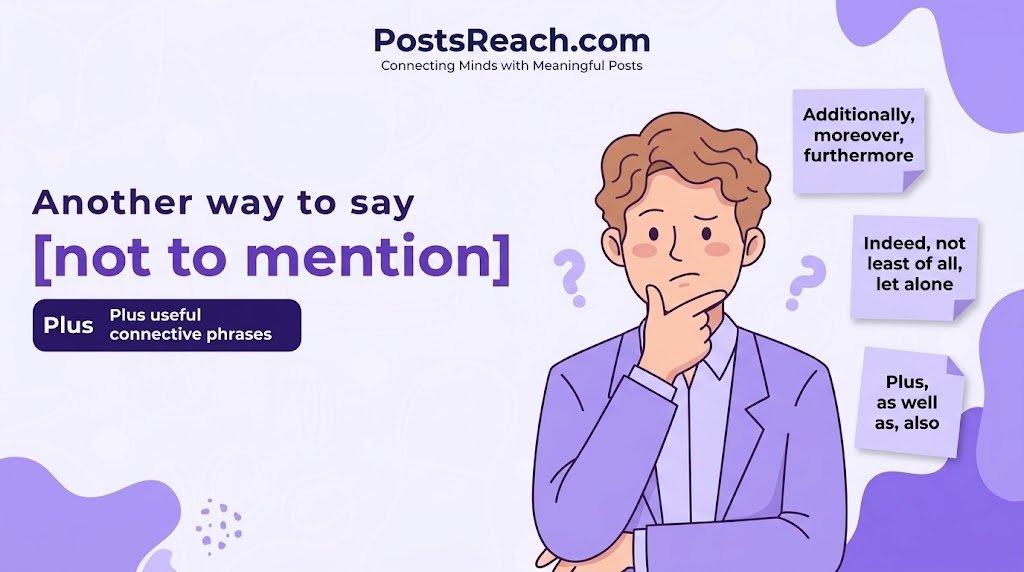
Another way to say “not to mention” includes “in addition to,” “as well as,” “besides,” “to say nothing of,” “not to forget,” and “on top of that.” The best alternative depends on context. Use “in addition to” for formal writing, “besides” for casual conversation, and “to say nothing of” for emphasis.
Key Takeaways
- “Not to mention” adds another relevant point or emphasizes an additional fact.
- “In addition to” works well in professional and formal writing.
- “Besides” sounds natural in everyday American English.
- “To say nothing of” adds emphasis and often highlights something significant.
- Choose an alternative based on tone, sentence structure, and intended emphasis.
What Does “Another Way to Say Not to Mention” Mean?
The phrase “not to mention” is used when you want to add another fact that makes your previous statement stronger. It often introduces an extra benefit, problem, detail, or consideration.
For example, you might say, “The hotel is affordable, not to mention close to downtown.” Here, the second point adds another reason the hotel is appealing.
People commonly use “not to mention” in conversations, emails, essays, reviews, and professional communication. Because the phrase can become repetitive, writers often look for alternatives that better match their tone.
Why Use Other Ways to Say “Not to Mention”?
Using different expressions can make your writing more natural and precise. The best replacement depends on whether you are simply adding information or deliberately emphasizing an additional point.
Other alternatives can help you:
- Avoid repeating “not to mention.”
- Make professional writing sound more polished.
- Add information without changing the meaning.
- Create stronger emphasis when needed.
- Adjust your wording for formal or casual situations.
10 Best Other Ways to Say “Not to Mention”
1. In Addition To
Meaning
“In addition to” introduces another person, thing, fact, or benefit alongside something already mentioned. It is one of the most useful replacements for “not to mention” in professional and formal writing.
Best For
Professional, Formal, Polite
Example 1
In addition to managing the project, Maria trained three new employees.
Example 2
The apartment has a spacious kitchen in addition to two large bedrooms.
Quick Tip
Use “in addition to” when you want to add information clearly without creating a strong emotional emphasis.
2. Besides
Meaning
“Besides” can introduce another reason, fact, or consideration. It sounds natural and conversational, making it especially useful in everyday American English.
Best For
Casual, Friendly
Example 1
The restaurant is affordable, and besides, it is only a few blocks away.
Example 2
I don’t want to drive tonight. Besides, the weather is getting worse.
Quick Tip
“Besides” often works best when the additional point feels like another reason supporting what you just said.
3. As Well As
Meaning
“As well as” means “in addition to” and connects two related items. It can work in both everyday and professional writing, although sentence structure matters.
Best For
Professional, Formal, Friendly
Example 1
The course covers basic design skills as well as advanced editing techniques.
Example 2
She speaks Spanish as well as English.
Quick Tip
Use “as well as” when the additional item fits naturally into the same grammatical structure as the first item.
4. To Say Nothing Of
Meaning
“To say nothing of” emphasizes an additional point that is often important, surprising, or especially relevant. It usually creates stronger emphasis than a simple phrase such as “in addition to.”
Best For
Formal, Polite
Example 1
The renovation will require months of work, to say nothing of the expense.
Example 2
The position demands excellent technical skills, to say nothing of strong leadership abilities.
Quick Tip
Choose this phrase when the extra point deserves special attention rather than merely being added to a list.
5. Not to Forget
Meaning
“Not to forget” introduces another detail that the speaker or writer wants the reader to remember. It is useful when the added point might otherwise be overlooked.
Best For
Friendly, Casual, Polite
Example 1
The new office has better lighting and more space, not to forget the larger conference room.
Example 2
We need to pack sunscreen and snacks, not to forget enough water for everyone.
Quick Tip
Use “not to forget” when your purpose is to remind someone about an additional detail.
6. On Top Of That
Meaning
“On top of that” adds another fact or circumstance, often one that makes a situation more impressive, difficult, or surprising. It is common in conversational English.
Best For
Casual, Friendly
Example 1
The car is reliable, and on top of that, it gets excellent gas mileage.
Example 2
I missed the bus, and on top of that, my phone battery died.
Quick Tip
Use this expression when the new information builds on the impact of the previous point.
7. Furthermore
Meaning
“Furthermore” adds another supporting point to an argument or explanation. It is more formal than “not to mention” and works particularly well in structured writing.
Best For
Formal, Professional
Example 1
The proposal would reduce operating costs. Furthermore, it could improve customer satisfaction.
Example 2
The software is easy to use. Furthermore, the company provides extensive technical support.
Quick Tip
Use “furthermore” when adding a supporting argument rather than simply listing two objects or qualities.
8. Additionally
Meaning
“Additionally” signals that another piece of information follows. It is concise, clear, and common in business writing, reports, and other professional contexts.
Best For
Professional, Formal
Example 1
The position offers flexible hours. Additionally, employees receive paid training.
Example 2
The update improves performance. Additionally, it addresses several security issues.
Quick Tip
“Additionally” works especially well at the beginning of a new sentence when you want to introduce another related point.
9. Along With
Meaning
“Along with” means together with or in addition to. It is useful when mentioning another person, item, responsibility, or feature connected to the main subject.
Best For
Professional, Casual, Friendly
Example 1
Along with her regular duties, she helps organize company events.
Example 2
The package includes a carrying case along with a charging cable.
Quick Tip
Use “along with” when two things belong naturally in the same sentence or group.
10. And That’s Not All
Meaning
“And that’s not all” tells the reader or listener that another noteworthy detail is coming. It creates more emphasis and anticipation than a neutral addition.
Best For
Casual, Friendly, Warm
Example 1
The membership includes free classes, and that’s not all—you also get access to the online library.
Example 2
The hotel has a pool and a fitness center, and that’s not all; breakfast is included, too.
Quick Tip
Use this expression when you want the additional information to feel interesting or impressive.
Comparison Table
| Alternative | Best Used In | Tone |
|---|---|---|
| In Addition To | Professional writing, formal writing | Neutral |
| Besides | Conversations, casual writing | Casual |
| As Well As | General and professional writing | Neutral |
| To Say Nothing Of | Formal writing, emphasis | Formal |
| Not to Forget | Conversations, reminders | Friendly |
| On Top Of That | Conversations, informal writing | Casual |
| Furthermore | Essays, reports, arguments | Formal |
| Additionally | Business writing, reports | Professional |
| Along With | General and professional writing | Neutral |
| And That’s Not All | Marketing, conversation, informal writing | Enthusiastic |
Common Mistakes
1. Treating Every Alternative as an Exact Synonym
Not every alternative carries the same level of emphasis. “Additionally” simply adds information, while “to say nothing of” deliberately draws attention to the added point.
2. Using Casual Phrases in Formal Writing
Expressions such as “on top of that” can sound conversational. In a formal report or academic paper, “furthermore” or “additionally” may fit the context more naturally.
3. Choosing “Besides” Without Checking the Meaning
“Besides” can mean “in addition to,” but it can also introduce a reason or argument. Make sure the sentence communicates the intended relationship between the ideas.
4. Using “As Well As” Incorrectly
“As well as” should connect grammatically compatible elements. Poor sentence structure can make the phrase awkward or unclear, especially when connecting long clauses.
5. Adding Emphasis When You Only Need Information
If you simply want to introduce another fact, “in addition to” or “additionally” may be clearer. Phrases such as “and that’s not all” create a stronger, more promotional effect.
Frequently Asked Questions
What is the most professional way to say “not to mention”?
“In addition to,” “additionally,” and “furthermore” are useful professional alternatives. The right choice depends on the sentence. “In addition to” works well when connecting items within one sentence, while “additionally” and “furthermore” are useful for introducing another point in business writing, reports, presentations, and formal explanations.
What is a simple synonym for “not to mention”?
“Besides” is one of the simplest alternatives in everyday English. You can also use “as well as” or “in addition to,” depending on the sentence. For example, “The job pays well, besides offering flexible hours” adds another benefit without sounding overly formal or complicated.
Is “in addition to” the same as “not to mention”?
They are similar, but they are not always interchangeable. “In addition to” usually adds information in a neutral way, while “not to mention” can emphasize the importance or relevance of the additional point. In professional writing, “in addition to” is often a clearer choice when no special emphasis is intended.
Can I use “besides” instead of “not to mention”?
Yes, in many casual contexts. “Besides” can introduce another reason, fact, or consideration, but its meaning depends on sentence structure. For example, “Besides being affordable, the laptop is lightweight” works naturally when adding another positive feature to the first one.
What is a formal way to say “not to mention”?
Formal alternatives include “furthermore,” “additionally,” and “to say nothing of.” However, they serve slightly different purposes. “Furthermore” adds another supporting argument, “additionally” introduces another fact, and “to say nothing of” emphasizes an additional point that deserves attention.
What can I say instead of “not to mention” in an email?
For a professional email, “in addition to,” “additionally,” or “as well as” usually works well. For example, instead of saying, “The report is accurate, not to mention easy to read,” you could write, “The report is accurate and easy to read.” Choose the wording that keeps the message direct.
Is “furthermore” a good replacement for “not to mention”?
“Furthermore” can replace “not to mention” when you are adding another supporting idea, especially in formal writing. It is not the best replacement when you are simply listing features. In those cases, “in addition to” or “as well as” may preserve the original meaning more naturally.
How do I choose the right alternative to “not to mention”?
Start by deciding whether you are adding information or emphasizing it. Use “in addition to” for neutral additions, “besides” for casual conversation, “additionally” for professional writing, “furthermore” for formal arguments, and “to say nothing of” when you want stronger emphasis.
Conclusion
The best alternative to “not to mention” depends on what you want the sentence to accomplish. For neutral and professional writing, “in addition to,” “additionally,” and “as well as” are reliable choices. For casual conversations, “besides” and “on top of that” sound more natural. If you want to emphasize an important additional point, “to say nothing of” can create stronger impact.
Context also matters. A phrase that sounds natural in a conversation may feel too informal in a report or business email. Instead of replacing “not to mention” automatically, consider the relationship between your ideas and choose the expression that communicates that relationship clearly. The goal is not simply to avoid repetition—it is to make every sentence sound intentional and natural.

Tessa Langford is a research and features editor who focuses on turning detailed information into practical, easy-to-follow articles. Her editorial work emphasizes thorough research, useful context, readability, and content that answers the questions readers are actually asking.